
How multiple offset accounts work
An offset account can help reduce the interest payable on your home loan while keeping your savings within reach. And when something works, it makes sense to want more of it, right? Enter multiple offset accounts: a simple way to help maximise savings and make budgeting simpler.
What is an offset account?
An offset account is a transactional account linked to your home loan that can help you reduce the amount of interest charged on your home loan. Interest is charged against your home loan based on the difference between the loan balance and the offset account balance.
Introducing, homeowner Michael.
Michael has a $400,000 home loan and $30,000 in a 100% offset account. When interest is calculated on his loan, it’s only calculated on $370,000. Because interest is only charged on the difference between his loan amount and the balance of his offset account.
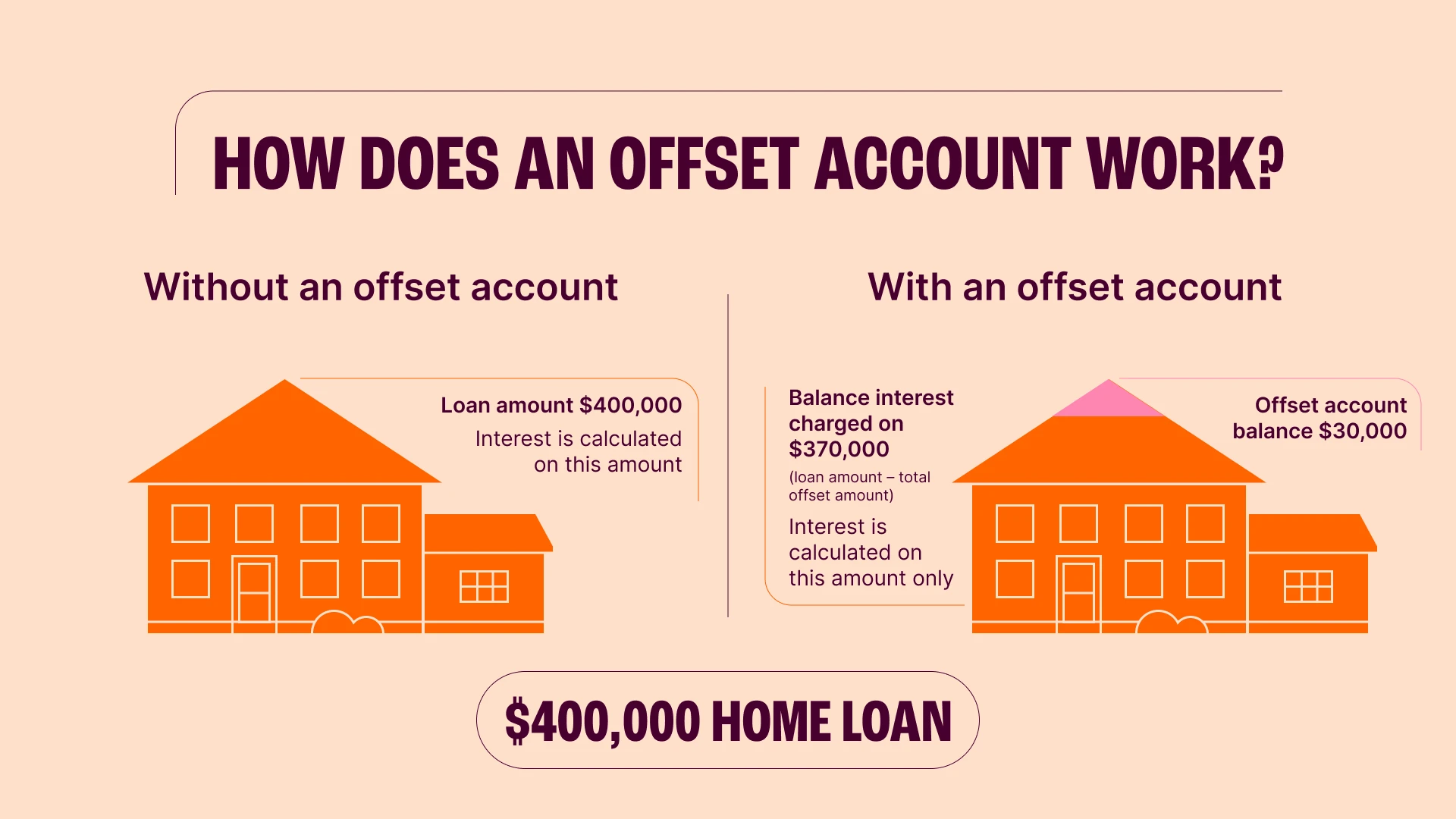
Put simply, the more money that you have in your offset account, the less interest you will likely pay over the lifetime of your home loan.
Here at BCU Bank, we offer owner occupiers a 100% offset account.
Did you know?
Some banks also offer partial offset accounts. Visit our blog explaining offset accounts to learn more about the different types.
How do multiple offset accounts work?
Multiple offset accounts build on the idea of offsetting your loan balance. By linking several offset accounts to your home loan, their combined balances help to reduce the loan amount interest is calculated on.
Let’s check back in with Michael.
We know that Michael already has a $400,000 home loan and $30,000 in a 100% offset account attached to his loan. He also has funds in a few other places:
- $7,500 in his ‘holiday’ savings account
- $2,500 in his ‘everyday’ transaction account
Instead of keeping these additional funds in separate accounts that don’t offset his loan, Michael opens two more 100% offset accounts and organises his money by goal. Because he now has a collective total of $40,000 ($30,000 + $7,500 + $2,500) in offset accounts, interest on his $400,000 home loan will only be calculated on $360,000. That’s $10,000 less than when he had only one offset account. Plus, he can still access his funds whenever he needs them.*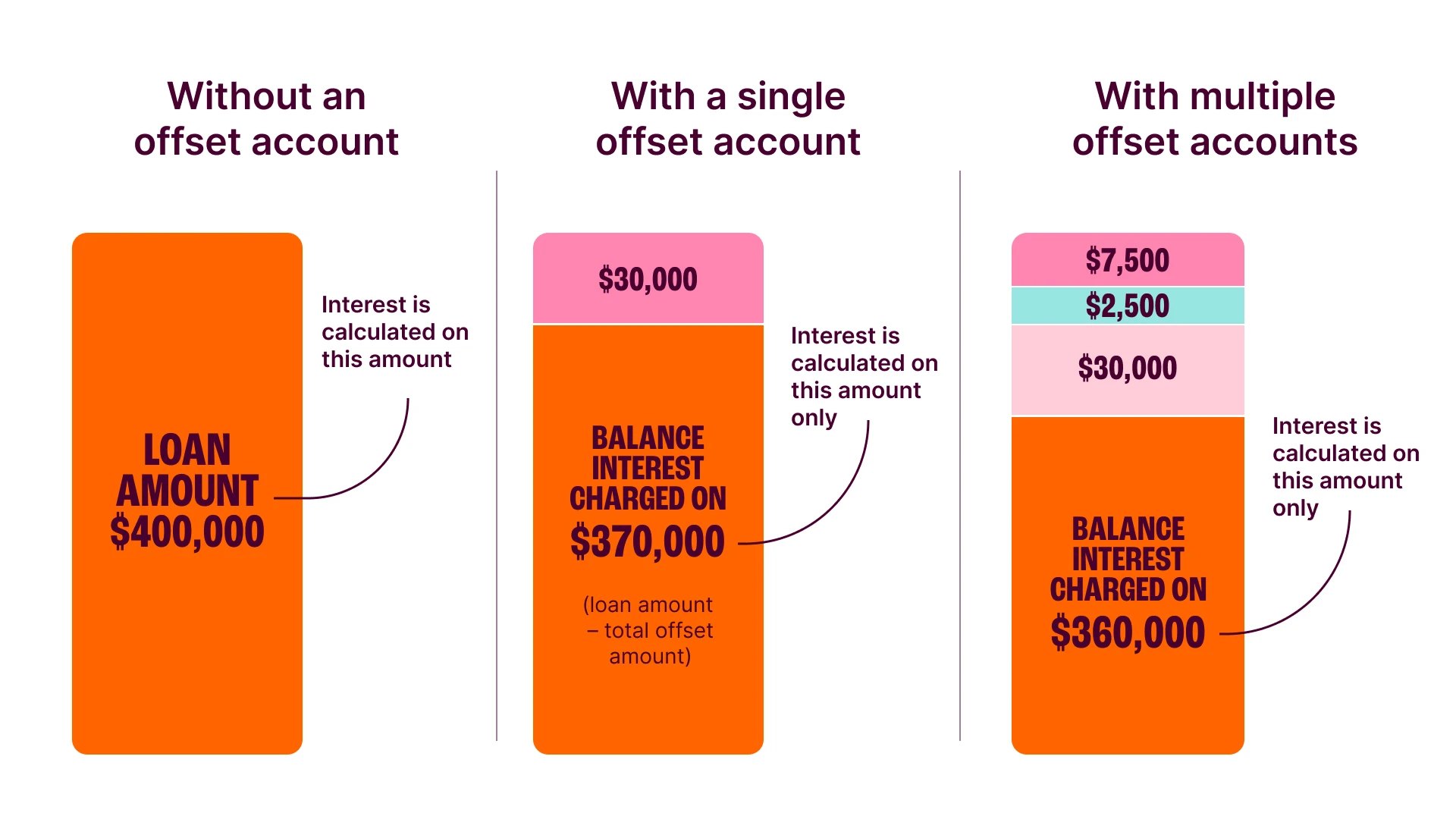
What are the benefits of multiple offset accounts?
Home loan interest rates are generally higher than any interest earnt on savings. While one offset account can help reduce interest over the life of your loan, multiple offsets could help you make your savings work even harder.
Benefits
- Increase interest savings. A larger combined offset balance means interest is calculated on a smaller portion of your loan, helping reduce what you pay over time.
- Make budgeting simpler. Dividing your money into offset ‘buckets’ can help you organise spending and savings for different goals.
- Support joint borrowers. Multiple offset accounts help each borrower contribute to reducing the loan balance while keeping some financial independence.
- Keep funds accessible. Your money stays within reach while still helping reduce the interest payable on your home loan.
If you’re weighing up which account could suit you best, comparing your options is a good first step. Try one of our handy savings or home loan calculators to see whether making the switch could be worthwhile.
How can you organise multiple offset accounts?
Setting up your offset accounts for different purposes can make it easier to stay on top of your money. Think of it as creating a set of budgeting buckets.
Your pay could go into a bucket for wages and bills, your savings could sit in another bucket, and your everyday spending money could have its own place too – your morning coffee included.
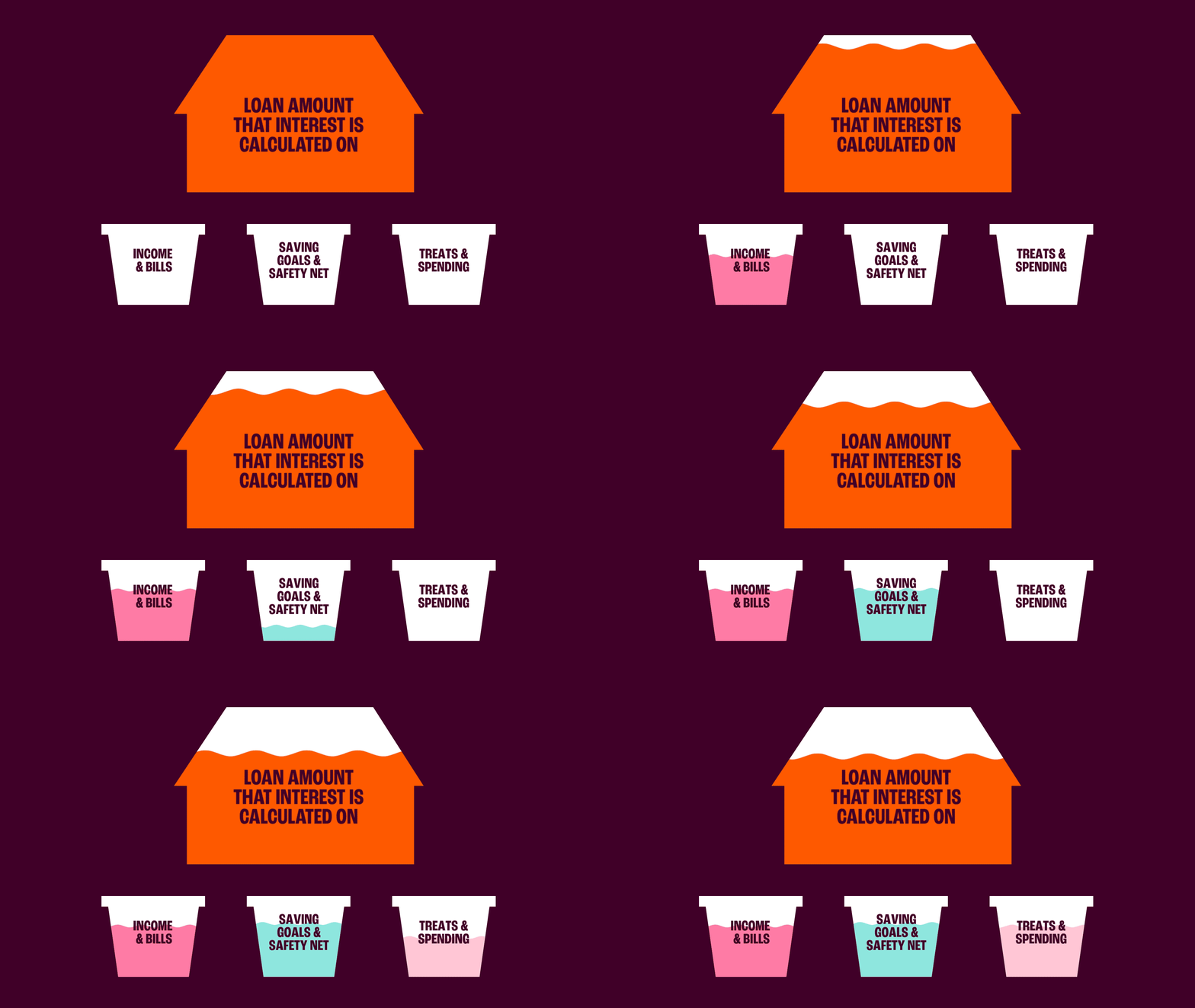
The more offset buckets you link to your home loan, the more purposeful you can be with your savings. At BCU, you can connect up to three Mortgage Offset Saver accounts to an eligible home loan, whether they’re in single or joint names.^
If you’re managing your loan on your own, your offset buckets might be set up like this:
- Offset account #1: Income and bills – for your pay to go in and your regular bills to come out.
- Offset account #2: Treats and spending – for the part of your income you set aside for the nice to haves, like coffee, meals out, and other activities.
- Offset account #3: Savings and safety net – for bigger expenses or emergency savings, such as saving for a new car.
Multiple offset accounts can also be arranged to work for joint home loan borrowers.
If you’re borrowing with someone else, your set-up could look like this:
- Offset account #1: Your day-to-day account – for your pay, regular bills and everyday purchases, including things like groceries or takeaway coffees.
- Offset account #2: Your partner’s day-to-day account – where your co-borrower may deposit their income and pay their share of bills and everyday expenses.
- Offset account #3: Shared goals and future planning – for money set aside for home maintenance, renovations or longer-term financial goals.
Using buckets can help you keep track of spending and put your money where it needs to go, while also supporting your goal of reducing the interest payable on your home loan.
How do I open multiple offset accounts?
To get started, you'll need an eligible BCU Bank home loan. Once your loan is set up, you can link up to three offset accounts to it, including any existing Access Account you choose to convert into an offset account.
You may also be interested in:

Five easy ways to save money on your home loan today
With the cost of living rising, it’s important to make sure you’re making the most of your money. Here are five ways you could save on your home loan

Home lending specialists

Love and money: How to manage money as a couple
Whether you’re moving in together, exchanging vows, or starting your joint savings journey, here are our tips on how to manage money as a couple.
Important information
Banking and Credit products issued by Police & Nurses Limited (BCU Bank).
Any advice does not take into account your objectives, financial situation or needs. Read the relevant terms and conditions, before downloading apps or acquiring any product, in considering and deciding whether it is right for you. The Target Market Determinations (TMDs) are available on our website or upon request.
This content is provided for general informational and educational purposes only and does not constitute financial product advice, credit assistance, or a recommendation of any kind. The information does not take into account your personal financial situation, objectives, or needs. BCU does not provide financial advice and you should consult your accountant or financial adviser.
*This does not take into consideration any interest earned.
^Accounts must be in the name of one or more (or all) of the home loan borrowers.